
In modern metal fabrication, woodworking and panel processing facilities, installing overhead electric lifting equipment is not always feasible or economical. Some production bays have limited power availability; mobile or outdoor staging zones cannot easily route power cables to a jib crane or bridge track. To work around these facility constraints without an expensive electrical retrofit, plant engineers turn to pneumatic sheet metal vacuum lifters. Driven entirely by a standard workshop compressed-air line, these systems deliver reliable, high-speed material handling.
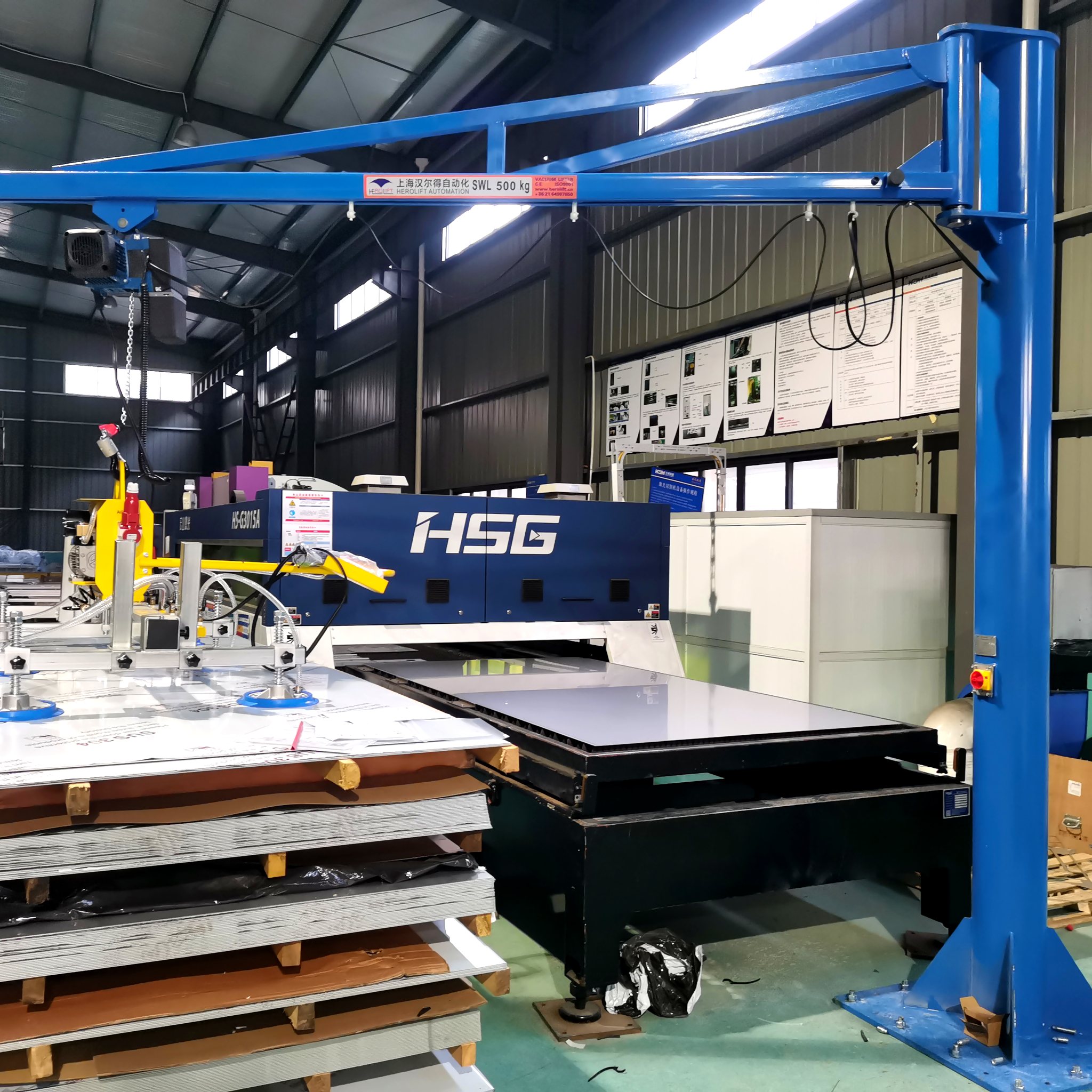
Why Choose Pneumatic Over Electric Vacuum Lifters?
Electric vacuum lifters, such as the Herolift BLA electric series, are widely deployed on fixed indoor CNC laser cutting lines. Pneumatic board lifters are engineered for a different constraint: they operate where there is no electrical power supply. The differences that matter on the shop floor are:
- No electrical power required on the beam. Pneumatic models operate entirely on 6-bar (0.6 MPa) compressed air, eliminating the need to route heavy 220 V or 380 V power cables along an overhead jib crane or bridge track.
- No electric motor, switches or live circuits on the lifting beam. Because the beam itself carries no electrical components, the lifting structure has no live circuits or electric motor mounted on it.
- Lower maintenance and high durability. A pneumatic system uses no electric rotary-vane pump that needs periodic carbon-vane replacement, and it requires no electrical-box troubleshooting, an advantage on dusty, humid or high-temperature factory floors.
An Important Note on Explosion-Proof Requirements
A pneumatic lifter removes electrical equipment from the lifting beam. This does not, however, mean that a standard BLA pneumatic model is supplied as an explosion-proof (ATEX or CNEX certified) unit. Herolift’s explosion-proof product line is the compressed-air-driven tube lifter and trolley series, which holds CNEX national explosion-proof certification and is marked Ex c III 80 °C Db (dust) and Ex c II T6 Gb (gas), built in 304/316L stainless steel with anti-static grounding below 100 ohms.
If your site has a classified hazardous area, contact our engineers to confirm the correct product line rather than assuming a standard pneumatic board lifter will qualify.
Technical Overview: The Herolift Pneumatic Board Lifter Range
Shanghai Herolift’s pneumatic board lifters are engineered in compliance with EU CE standard EN 13155:2003, American ASME B30.20 and German UVV18, and are purpose-built for non-porous panel surfaces including carbon steel, aluminum, plastic sheets, glass and laminated chipboard.
Model Range and Specifications
| Model Number | Rated Load Capacity (SWL) | Pad Configuration | Drive Power Source | Gripper Capacity per Pad | Own Weight |
|---|---|---|---|---|---|
| BLA200-8-P | 200 kg | 8-pad multi-point array, Ø230 mm | Compressed air, 6 bar | 125 kg | 125 kg |
| BLA250-4-P | 250 kg | 4-pad array, Ø230 mm | Compressed air, 6 bar | 125 kg | 120 kg |
| BLA400-6-P | 400 kg | 6-pad array, Ø230 mm | Compressed air, 6 bar | 125 kg | 130 kg |
On naming: the product catalogue groups these units under the heading “Pneumatic Lifter BLP”, while the individual model codes follow the standard BLA board-lifter naming convention.
Core Safety and Control Features
- Multi-stage vacuum generation. The vacuum lifter uses a Korea DRMG vacuum generator, a multi-level unit rated at 355 L/min with a maximum vacuum degree of up to 92%. It requires no power, runs quietly, is small and portable, and needs no maintenance, forming the core of the vacuum system.
- Integrated vacuum reservoir and non-return valve. The structural main beam itself serves as an airtight vacuum reservoir, welded and air-tightness tested. If the air supply suddenly drops, the system locks vacuum pressure to prevent accidental load drops. The holding time after a power failure is at least 30 minutes, against the 10 minutes required by the EU CE standard.
- Individual pad isolation. Each suction cup is fitted with a manual ball valve. Operators can shut off outer pads when switching from full master sheets to smaller cut blanks without losing vacuum integrity, so one unit can handle plates of different specifications.
- Multi-point, spring-buffered suction. Six Ø230 mm NBR pads distribute lifting force evenly across the top surface and keep the metal sheet level, preventing it from sagging or running off the straight during handling.
- Sound-and-light alarm. A vacuum pressure alarm unit with an independent rechargeable battery provides a visual and audible warning if vacuum drops below the set threshold.
- Safety factor. The system is designed with a horizontal lifting safety factor of S greater than 2.0.
- No edge damage from mechanical clamps. Face-contact vacuum pads grip only the top surface, avoiding the edge chipping, scratching and deformation caused by mechanical plate clamps.
Technical Prerequisites for Selecting a Pneumatic Lifter
Before specifying a pneumatic vacuum lifter for your workstation, procurement and engineering teams should verify three baseline parameters:
- Compressed air stability. Ensure the facility air line delivers a consistent 6-bar (0.6 MPa) clean, dry air supply at the point of use. The BLA400-6-P consumes 75-94 L/min of compressed air.
- Material air-tightness. Vacuum attachment requires an even, non-porous surface. The reference technical proposal specifies sheets with an “even, smooth, densified” surface, since a porous or rough surface will leak air and fail to hold vacuum.
- Overhang and thickness limits. The BLA400-6-P reference application handles sheet sizes from 1.3 x 2.5 m to 1.6 x 3.1 m, sheet thickness of 0.8-6 mm, and single-sheet weights of 20-360 kg. Exceeding the allowable overhang beyond the outer suction pads can permanently bend thin sheets under their own weight, so always share your maximum sheet dimensions and minimum thickness with our engineers for load-distribution verification.
Conclusion: Simplify Your Material Handling Infrastructure
For workshops where routing power to an overhead lifting beam is impractical, a pneumatic sheet metal vacuum lifter offers a straightforward route to safer, damage-free panel handling, without electrical equipment on the lifting structure and without the complexity of a power retrofit. Backed by Shanghai Herolift’s two decades of manufacturing expertise and compliance with EU CE, ASME B30.20 and German UVV18, these units address specific, well-defined workshop constraints.
A standard pneumatic board lifter is not an explosion-proof unit. If you require certified protection for a hazardous area, our CNEX-certified tube lifter and trolley range is the correct starting point.
Contact Shanghai Herolift to confirm the correct model for your sheet dimensions, thickness and available air supply.
Post time: Nov-13-2026