
A 25 kg sack of ingredient has no handle, no rigid edge and no predictable shape. Pick it up by hand and the load shifts as the product settles; pick it up with a hook and the bag tears. That is why sacks and big bags sit at the awkward end of material handling — heavier than a carton, less rigid than a drum, and far less cooperative than a steel plate.
This page compares the two realistic options for a plant moving sacks every shift: manual handling, and a vacuum bag lifter. It is written for the person who has to justify the purchase, so the numbers are laid out as a calculation you can redo with your own figures rather than as a vendor claim.
Why sacks are harder to automate than they look
Four properties decide whether a lifting aid will work on your bags:
- Porosity. Woven polypropylene sacks leak air through the weave. A flat suction pad will not hold a seal on them, which is why bag work usually needs a dedicated bag attachment rather than the pad used for cartons.
- Deformation. A filled sack slumps. The pick point moves depending on how full it is, so the attachment has to tolerate a range of shapes rather than one.
- Surface condition. Flour dust, sugar dust and talc all sit on the bag surface and break the seal exactly where you need it.
- Weight variance. A nominal 25 kg sack is rarely 25 kg. Filling tolerance, moisture and product density move the real figure, and the lifter has to be rated for the top of that range, not the label.
None of these are reasons to give up on vacuum. They are the reasons a bag attachment is a different product from a sheet-metal pad, and why the specification conversation starts with the bag, not the load weight.
What changes when the vacuum does the lifting
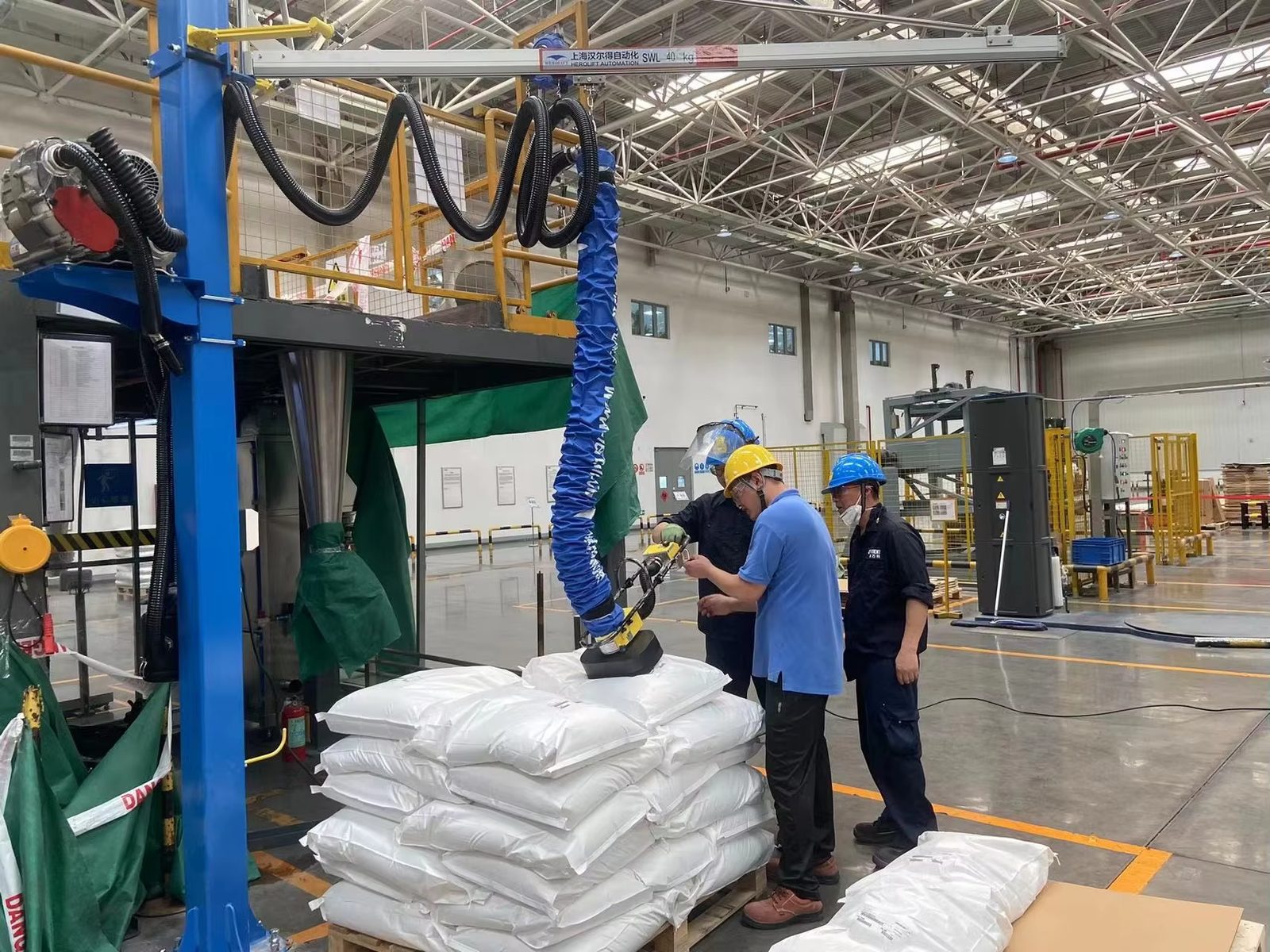
A vacuum bag lifter holds the sack by its own surface. The operator positions the attachment, triggers vacuum, and the tube or mast takes the weight; the operator steers rather than carries. Three things change immediately:
- The load leaves the spine. The operator no longer supports 25 kg at arm’s length or twists with it. They guide a load that is already balanced.
- Placement gets accurate. A sack can be lowered into a hopper, onto a pallet layer or into a mixer mouth without the swing that comes from carrying it.
- Rate becomes predictable. Cycle time stops depending on who is on shift.
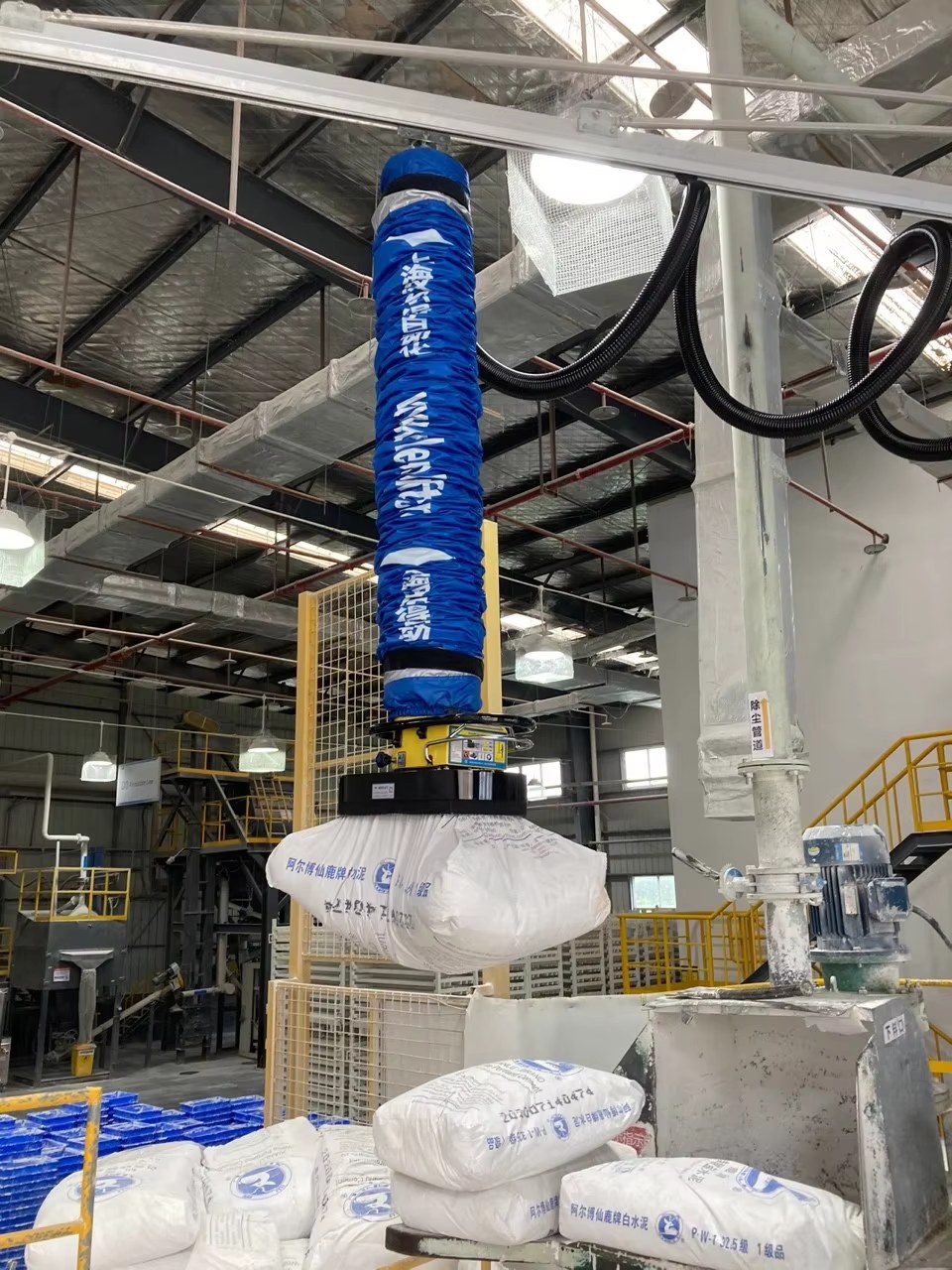
Our vacuum tube lifters cover 10 kg to 300 kg with bag and sack attachments, and the vacuum component range includes the pads and attachments used for paper and plastic sacks. Units are built to a horizontal lifting safety factor above 2.0 and are CE-marked under EN 13155:2020.
Four ways to move a sack, side by side
| Method | Load range | Operator effort | Best for | Where it fails |
|---|---|---|---|---|
| Manual handling | Any, but limited by the person | Full load carried | Low volume, mixed tasks | Repetitive shifts, tall stacks, restricted reach |
| Vacuum tube lifter | 10–300 kg | Guides only | Single position, high repetition | Very porous weave without a bag attachment; dusty surface |
| Mobile vacuum lifter | Matched to the tube lifter it carries | Guides only | Several positions on one floor | Rough floors, tight aisles, ramps |
| Sack hoist or crane | Higher loads | Slinging and steadying | Big bags, single drop points | Slow changeover, needs a sling and a clear hook path |
If the job is one position and one bag size, a fixed tube lifter is the cheapest capable answer. If the same operator has to serve a mixer, a pallet and a staging area, a mobile vacuum lifter avoids buying three fixed units — at the cost of floor condition and aisle width.
Throughput: where the seconds actually go
Bag handling cycle time has four components, and only one of them is lifting:
- Reach and position the attachment
- Attach and confirm vacuum
- Lift and travel to the drop point
- Release and return
Manual handling compresses steps 1 and 2 to almost nothing and inflates step 3, because the load is carried at walking speed with a postural cost. A vacuum lifter does the opposite: attachment takes a moment, travel is at the speed of the tube or mast, and the operator finishes the shift with the same capacity they started with.
Worked example — assumptions stated, not measured on your line. Take a plant moving 200 sacks per shift at a nominal 25 kg, with 15 m average travel to the drop point. If manual handling averages 18 seconds per sack and a tube lifter averages 11 seconds, the saving is 7 seconds × 200 sacks = 1,400 seconds, or about 23 minutes per shift. At three shifts and 250 working days, that is roughly 290 hours a year. Whether that is worth the capital depends entirely on what an hour of that operator’s time is worth to you — which is the next section.
The injury side, without the invented statistics
Most EHS teams already screen manual lifts with a recognised tool such as the NIOSH lifting equation or their own internal threshold. You do not need a vendor to tell you that repeatedly lifting 25 kg from floor level with a twist is a musculoskeletal risk; your incident log and your insurer already have a view.
What is worth stating plainly: a vacuum lifter does not remove the risk, it removes the load. The operator still walks, still positions, still works a shift. What changes is that the spine is no longer carrying the product, and the load path is predictable enough to write into a safe system of work — including the vacuum gauge, the safety reserve and the two-hand control that stop a dropped load.
The mechanisms behind that — how the pad seals on a bag, what the safety reserve does and why the controls are two-handed — are set out in The Secret to Safe Bag Lifting Revealed.
Payback: the calculation, not the promise
Run the numbers in this order and the decision usually makes itself:
- Sacks per year = sacks per shift × shifts × working days
- Seconds saved per sack = manual cycle time − assisted cycle time (time it on your own floor, do not take a vendor figure)
- Hours saved per year = (1 × 2) ÷ 3600
- Labour value saved = hours × loaded hourly cost
- Add the incident-side saving your own claims history supports — if you cannot quantify it, leave it at zero rather than guessing
- Compare with the installed cost of the unit, including the jib or rail, the air supply and the commissioning time
Two honest cautions. First, seconds saved only become money if the freed time is used — if the line is not the constraint, the saving is comfort, not cost. Second, in a food plant the washdown and changeover requirements can add cost that a metal fabrication shop never sees; check the attachment material and cleaning routine before comparing quotations.
Where a vacuum lifter is the wrong answer
It is worth saying this plainly, because it saves a bad project:
- Porous woven sacks with fine product and no bag attachment. The seal will not hold. Specify the attachment first.
- Frozen or agglomerated product in a rigid block. The bag surface becomes irregular and the pick is unreliable.
- One lift a week. The capital will not pay back; a sack trolley and a trained team is the correct answer.
- No compressed air and no appetite for a compressor. Vacuum tube lifters need an air supply; an electric unit changes the calculation.
What to send us for a specification
Six facts get you a real answer instead of a brochure:
- Bag type, material and whether it is woven or lined
- Weight range, minimum to maximum, not the nominal figure
- Sacks per shift and the number of drop positions
- Lift height and travel distance, including any mezzanine or pit
- Available air pressure and whether the area is washdown or ATEX classified
- Floor condition and aisle width if a mobile unit is being considered
Send those and the answer is a unit and an attachment, not a range of options. For food-grade and cleanroom applications, the industry pages set out what changes in those environments.
FAQ
Can a vacuum lifter pick up a woven polypropylene sack?
Only with a bag-specific attachment. A flat suction pad loses its seal on a woven surface because air passes through the weave; the attachments used for sacks and paper bags are designed around that leakage rather than fighting it. Tell us the bag construction and we will specify the attachment rather than the pad.
What weight of sack can one operator handle?
The lifter is rated for the load, and our tube lifters cover 10 kg to 300 kg. The practical limit is usually the bag’s own stability and the operator’s reach, not the machine — a 50 kg sack that slumps unpredictably is harder to place than a 100 kg one that holds its shape.
Is a vacuum lifter safer than a sack hoist?
They solve different problems. A hoist lifts more but needs slinging, a clear hook path and a second person for some loads. A vacuum lifter is faster to attach and keeps the operator’s hands on the load. For repetitive handling at one or two positions, the vacuum unit usually wins on cycle time; for big bags at a single drop point, a hoist is often simpler.
How long does installation take?
It depends on whether a jib, rail or mast has to go in first. A tube lifter on an existing structure is a day of work; a new column-mounted jib with a poured base is a longer site job. We would rather quote the two separately than give you a single optimistic number.
Post time: Nov-23-2026