
Fabric Roll Handling
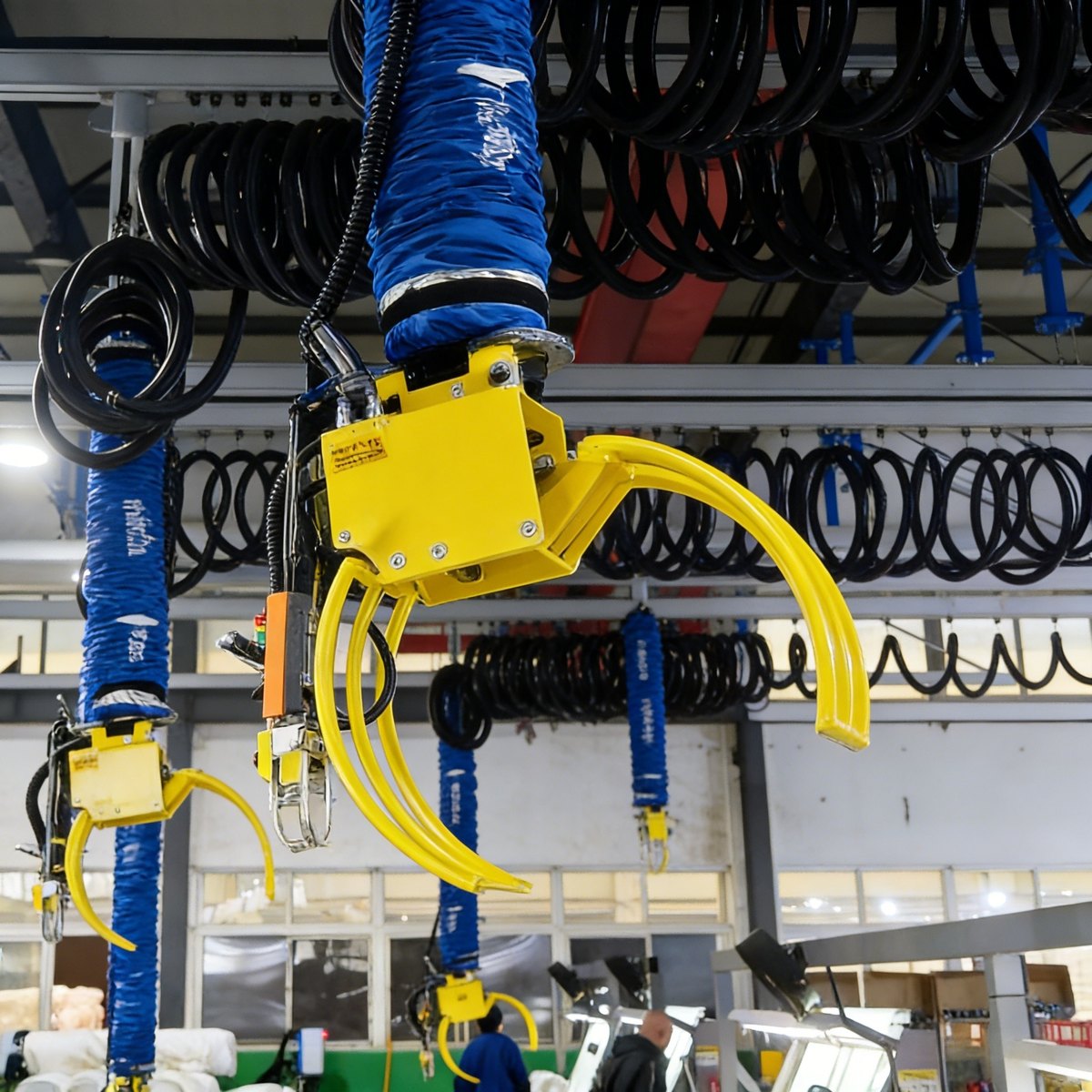
Fabric rolls leave the loom as horizontal cylinders — typically 1,000–1,600 mm long, up to 450 mm in diameter and 30–80 kg in the jobs we have logged, wrapped in film and stacked on pallets. A VEL vacuum tube lifter handles them on a pad or a roll gripper, carried by a column jib, a ceiling bridge track or a mobile base.
Pad, Core Gripper or Squeeze Arm
Three tools, one quick-release coupling. The roll decides which one.
Vacuum pad
Seals on the outer wrap of a tight, film-wrapped roll. No core needed, both roll ends stay free.
30–80 kg in our records
Inner-core gripper
Expands inside the paper core and takes the load off the seal altogether.
up to 270 kg
Outer squeeze arm
Clamps the roll from both ends; indifferent to surface and packaging film.
up to 270 kg
| Tool | What it holds | Roll weight |
|---|---|---|
| Vacuum pad | Outer wrap of a tight roll | 30–80 kg in our records |
| Inner-core gripper | Inside the paper core | up to 270 kg |
| Outer squeeze arm | Both ends of the roll | up to 270 kg |
All three rotate 360°, so a roll can be lifted horizontally, turned on its axis and offered to an unwinding shaft. The gripper closes on a pneumatic cylinder and needs 0.6 bar of air at the column; vacuum only drives the lift. Rated capacity is set at 1.1× the heaviest roll — an 80 kg roll needs 88 kg, which is why the 90 kg VEL180 qualifies. A recent build for 1,000–1,600 mm rolls of up to 450 mm diameter: VEL180/2.5-Flex on a pillar jib, 1.7 m stroke, about 240° rotation, 3.3 kW blower.
What 21 Installations Show
Between February 2023 and September 2026 our installation team logged 21 fabric-roll jobs. Sixteen ran on VEL tube lifters. The other five are the honest boundary of these numbers: two used a ceiling bridge track with a non-standard fixture, one a rail-mounted balancer, one a 300 kg balancing hoist, and one the CT100SS trolley for nonwoven film. Eighteen of the 21 are in Zhejiang and Jiangsu, nine of them in the Hangzhou area. Seven of the nine jobs that state a weight sit at 80 kg.
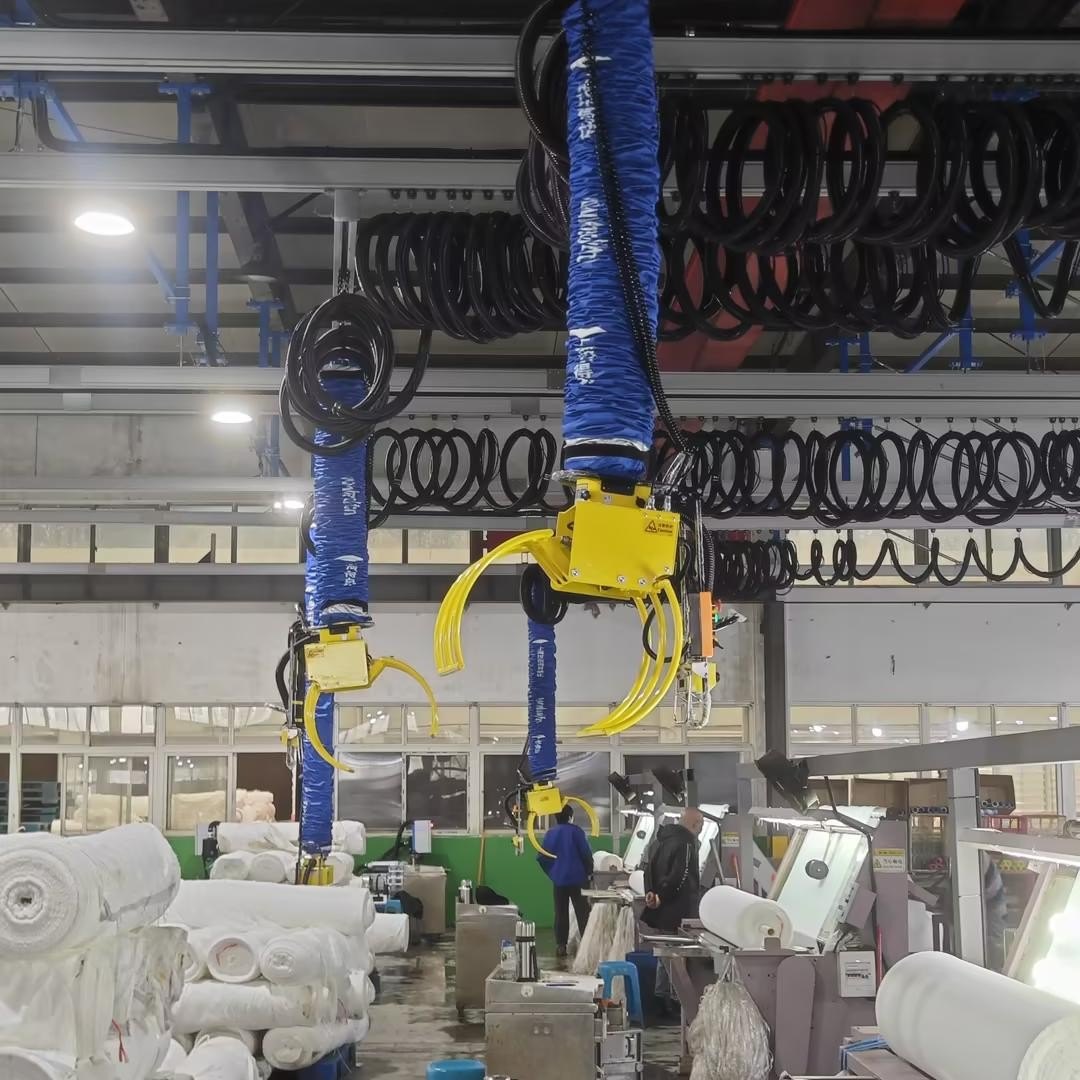
The 80 kg band is served by both the 90 kg VEL180 and the 140 kg VEL230, and the choice between them is settled by roll length and wrap rather than by weight alone: a longer or film-wrapped roll gets the larger tube, because holding force depends on the sealed pad area and on stability, not on nominal capacity. Five of the sixteen VEL jobs ran on a ceiling bridge track, four on a column or articulated arm, and one on a mobile base. Two orders were multi-unit — three lifters and four lifters on a single line — and each took two to three days to commission.
The longest roll on record is 1,550 mm at 79 kg. The first pad was shorter than the roll, the centre of gravity sat outside the supported band, and the roll dipped as it left the floor. Lengthening the pad by 200 mm, widening it by 20 mm and reducing the cavity height by 10 mm fixed it.
Three Failures We Have Already Fixed
- Pad shorter than the roll. The centre of gravity falls outside the supported band, one end dips and the seal breaks. Pad length is matched to the longest roll, and the roll is picked up on its balance point.
- Trapped air under the film. The first lift pulls partial vacuum against air between the film layers, the pad appears to hold and then releases. Hold until the gauge is stable and keep the pad cavity shallow.
- Roll outside the stroke. A chain extension too short, or a handle 300 mm short of a comfortable grip. Stroke and handle length are set from the pick and set-down heights before the order ships.
Column, Ceiling Track or Mobile Base
Column jib
The roll stays at one workstation. Short, repeatable moves, no ceiling structure needed.
Ceiling bridge track
The roll travels the line. Keeps the floor clear and the column out of the traffic path.
Mobile base
The lifter follows the work between bays. Costs a battery and a wider footprint.
Six Things We Need
- Roll length and diameter at both extremes of the line.
- Heaviest roll, including the packaging film.
- Surface and wrap — bare fabric, film, or paper interleaf; this decides whether a pad is viable.
- Winding — tight industrial roll, or looser.
- Core diameter, if the roll has an accessible core.
- Pick and set-down heights, plus one photo of the workplace.
Tell us early if the workstation has no compressed air: a cylinder-closed gripper needs 0.6 bar, and that changes the layout.
FAQ
Yes. The pad contacts the outer film or surface only; nothing clamps or hooks the fabric.
80 kg on a pad in our records, and up to 270 kg with a customised roll gripper, with rated capacity set at 1.1× the heaviest roll.
Trapped air between the film layers. Hold the pad until the gauge is stable, and keep the pad cavity shallow.
Yes — pad and gripper share the same quick-release coupling, so the tool changes in minutes.
Yes, with a quick-change pad and a stroke that covers the smallest and largest roll; the pad head sits on the same coupling.
Yes, when it carries a roll gripper. The head rotates 360°, so the roll can be turned on its axis and offered to an unwinding shaft or a machine chuck; a pad cannot do this, because the roll rotates out of the seal.
A column is enough inside one workstation. If the roll travels along the line, the ceiling bridge track is the right choice.
One day for a single unit, two to three for a three- or four-unit line, four to seven for a ceiling track.
Send the Roll Data, Not a Description
Weight, diameter, length, winding, core and a photo are enough to size the tool and the support.