
Sheet metal handling covers three different jobs that are often talked about as one: getting a blank onto the machine, taking the finished part off, and moving material between stations. A laser cell, a punch press and a shear each break those jobs down differently, which is why the same workshop can need two or three different lifting methods on the same floor.
This page compares the six options we build and see in service, and — more usefully — the specific conditions where each one stops working. If your process is not listed, send the load details and we will specify from the same range.
Start With the Load, Not the Equipment
Most wrong choices are made before anyone looks at a catalogue. Five questions settle the shortlist faster than any comparison table:
- Sheet size and thickness. A 3000 × 1500 mm sheet in 1 mm mild steel weighs about 35 kg. The same footprint in 10 mm weighs roughly 350 kg. Weight, not area, decides the lifting class.
- Surface condition. Oiled, galvanised, brushed or polished sheet changes which pads will hold and whether a clamp is acceptable at all.
- Finish requirement. If the face cannot be marked, mechanical grabs and hooks are out before the discussion starts.
- Machine cycle. A shear that cuts every 40 seconds and a laser that runs unattended for an hour need different answers, even for identical sheets.
- Headroom and power. Column-mounted equipment needs a foundation and clear swing space. Vacuum equipment needs either compressed air or a power supply.
The Six Options
1. Overhead crane with slings, clamps or a spreader beam
The default in most fabrication shops, and still the right answer for thick plate and awkward shapes. It needs no floor space, handles any weight the crane is rated for, and every operator already knows how to use it. Its weakness is contact: clamps mark the edge, slings need a hooking point, and neither is fast when the mix changes every few minutes. For finished or coated sheet, the crane is usually the backup, not the primary.
2. Jib crane with a vacuum sheet lifter
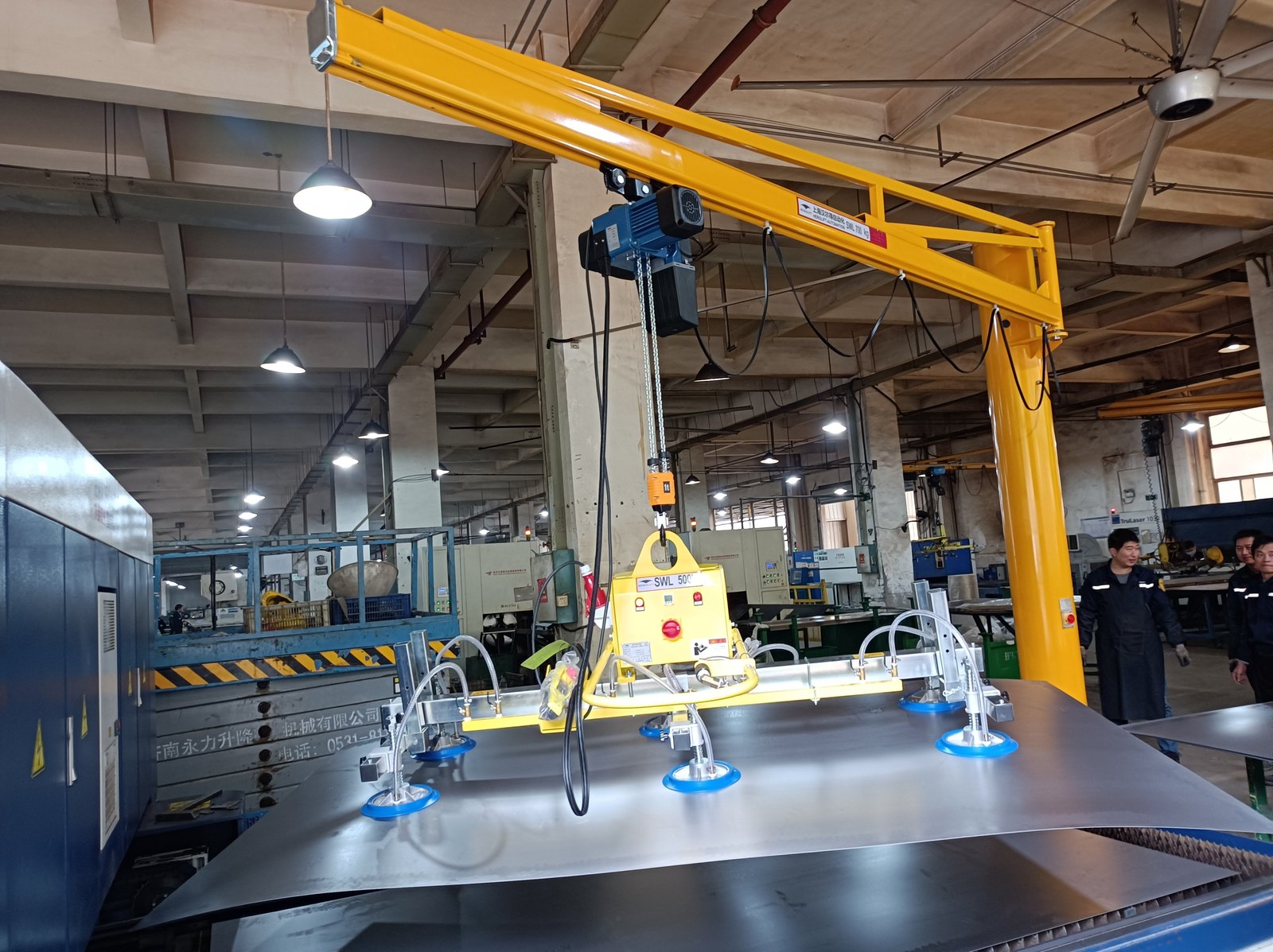
A column or wall-mounted jib carrying a vacuum lifter puts the lifting device exactly where the machine needs it, with no trolley travel to waste. Our jib crane systems are built around the lifter they carry, in column, wall and rail versions. This is the most common configuration for single-machine load and unload, because the jib can be positioned once and then used for years without re-rigging. The constraint is coverage: a jib serves a circle, and that circle has to include the stack, the machine bed and the outfeed.
3. Vacuum tube lifter
The tube lifter is the light end of the range — our tube lifters run from 10 kg to 300 kg — and it earns its place on smaller sheets, nested blanks, offcuts and parts that come off a press at speed. One hand on the handle moves the load; the suction head does the gripping. It is fast, but it is not a full-sheet tool: above roughly 300 kg, or on sheets large enough that the load sags between pads, a different class of equipment is needed.
4. Vacuum plate and heavy sheet lifter
This is the class built for whole sheets: our heavy lifters cover 500 kg to 3000 kg, with 20 t units for thick plate. Multiple pads spread the load across the sheet face, which is what keeps a thin panel from bowing as it comes off the bed. When the sheet is the load — not a part cut from it — this is usually the only vacuum option that holds its shape.
5. Rigid-arm pneumatic manipulator
A manipulator trades reach for rigidity — see rigid-arm pneumatic manipulators. The arm holds a gripper at a fixed orientation, so the part arrives at the fixture already aligned, and the operator is guiding rather than carrying. It suits repetitive handling of parts and small assemblies where the same motion repeats hundreds of times a shift. It is a poor fit for full sheets, where the reach and the pad area both run out.
6. Mobile vacuum lifter
A wheeled unit — our VEL and VCL series — that can be rolled to whichever machine needs it. This is the option for workshops where the lifting requirement moves during the week, or where a fixed installation cannot be justified by utilisation. Throughput per unit is lower than a dedicated jib, and floor space has to be kept clear, but it removes the “we only have one lifter and it is at the other end of the shop” problem entirely.
Side-by-Side Comparison
| Option | Typical load | Contact with the face | Floor space | Needs air or power | Where it fails |
|---|---|---|---|---|---|
| Overhead crane + sling or clamp | Any rated load | Clamp marks edges; sling needs a hook point | None | No | Finished faces, fast mix changes |
| Jib crane + vacuum sheet lifter | Matched to the lifter it carries | None — pads only | Column footprint + swing | Air (or electric vacuum) | Only covers one circle; re-siting is a project |
| Vacuum tube lifter | 10–300 kg | None | None (rail or jib mounted) | Air | Full sheets, loads above 300 kg |
| Plate / heavy sheet lifter | 500–3000 kg, up to 20 t | None | Depends on mounting | Air or electric | Small parts, tight access, mixed small batches |
| Rigid-arm manipulator | Parts and small assemblies | Gripper-dependent | Base footprint | Air | Full sheets, long reach requirements |
| Mobile vacuum lifter | Light to medium | None | Clear aisle to move through | Battery or air | High-cycle single-machine work |
Where Each Option Breaks Down
The failure modes matter more than the specifications, because they decide whether a project still works six months after installation. They also vary by material — our industry pages separate sheet metal from glass and stone for that reason.
Oiled or porous sheet. Vacuum needs a sealed surface. Oiled steel holds reasonably well with the right pad; porous or unsealed board does not, and needs a porosity test before anything is ordered. If the surface cannot be sealed, no amount of pad area will fix it.
Thin gauge. A 0.8 mm sheet lifted from four points will bow between them. The fix is more pads spread wider, not a bigger pump — which is why sheet lifting is a pad-layout problem before it is a vacuum problem.
No compressed air. Every vacuum option above assumes air, except the electric and battery units. Workshops without a ring main should say so at the enquiry stage; it changes the model, not just the price.
Floor space and foundations. A column jib needs a base and a clear swing. If the machine is boxed in by racks, a rail system or a mobile unit is the realistic answer, even though the jib would perform better.
Narrow aisles and low headroom. A column jib needs its base out of the traffic path and its boom clear of the roof structure. In a bay that is already tight, a rail system hung from the building steel often fits where a column cannot, and a mobile unit fits where neither can.
Mixed sizes on one machine. A lifter set up for 3000 × 1500 mm is clumsy on a 500 mm offcut. Where sizes vary widely, plan for two devices or accept that the small work goes by hand.
Matching the Option to the Machine
Different machines load differently, and the handling equipment should follow the machine rather than the other way round.
Laser cutting. The pattern is load full sheet, cut, unload skeleton and parts. Full-sheet load points to a plate lifter; the skeleton and parts point to a tube lifter or manipulator. Many cells end up with both, sharing one jib or rail.
Punch press and shear. Short cycles and constant operator attention. The lifting device has to be out of the way between strokes, which favours a jib that parks clear of the tool area rather than a fixed overhead arrangement.
Automated lines. Where the machine loads itself, the handling question moves upstream to destacking and staging. We cover that sequence in automatic loading and unloading in the sheet metal industry.
Staging and destacking
Most sheet handling projects fail upstream of the machine, not at it. A 3000 × 1500 mm sheet in 2 mm steel weighs about 71 kg, so a 30-sheet stack is over two tonnes, and pulling the top sheet off that stack by hand is where edges get damaged and hands get cut. A plate lifter set to lift one sheet, or a tube lifter with a small pad cluster for offcuts, solves the destacking problem before the machine ever sees the material.
Staging also decides how much of the cycle the operator spends walking. If the stack sits behind the machine and the finished parts go to a pallet in front, the handling device has to cover both — which is a jib-and-rail question rather than a lifter question.
What to Send for a Quote
- Maximum and minimum sheet size, and the thickness range in the materials you actually run
- Surface condition: oiled, dry, galvanised, coated, polished
- Machine type, bed height and the distance from stack to bed
- Cycle target: sheets per hour, or lifts per shift
- Available power: compressed air line pressure, or single/three-phase supply
- Headroom and the clear floor area around the machine
With those six answers we can name the class of equipment, the pad arrangement and the mounting in one reply, rather than a range of options that still needs narrowing.
FAQ
Can one lifter handle both full sheets and small parts?
Rarely well. Pad layouts that hold a 3000 mm sheet are too large and too widely spaced for a 300 mm offcut, and the vacuum reserve is wasted. Two devices sharing one jib or rail is usually cheaper than one compromised device.
Do I need a compressed air supply for a vacuum lifter?
For pneumatic units, yes — a stable air line at the pressure specified for the model. Electric and battery units exist for workshops without a ring main, and they are the correct choice rather than adding a compressor for one device.
How much vacuum is enough for oily steel?
It is not a pressure figure that decides, but the pad seal. Oiled sheet needs pads that resist sliding and a layout that keeps the oil film from reaching the seal edge. This is why we ask for the surface condition before quoting, not after.
What safety factor should I expect?
Herolift units are designed to a horizontal lifting safety factor above 2.0, and the CE documentation for the VEL and VCL series is certificate M.2024.204.C102318 to EN 13155:2020. Ask any supplier for the certificate number and the model list it covers, not just the standard it claims.
Where does a jib crane stop making sense?
When the machine cannot be reached by a single swing, or when the same lifter is needed at three machines. At that point a rail system or a mobile unit covers more floor for less structure.
Post time: Nov-20-2026