
Ask ten suppliers who the top advanced jib crane supplier in China is and you will get ten answers — each pointing at itself. The useful question is not who claims the title, but who can pass six tests any buyer can verify from outside the company: a certificate number you can check, a complete crane range rather than one model, real engineering documents, manufacturing depth, verifiable reference installations, and cross-border service that survives the container. This article lays out those six tests, applies them to a Shanghai manufacturer, and shows you how to score any candidate the same way.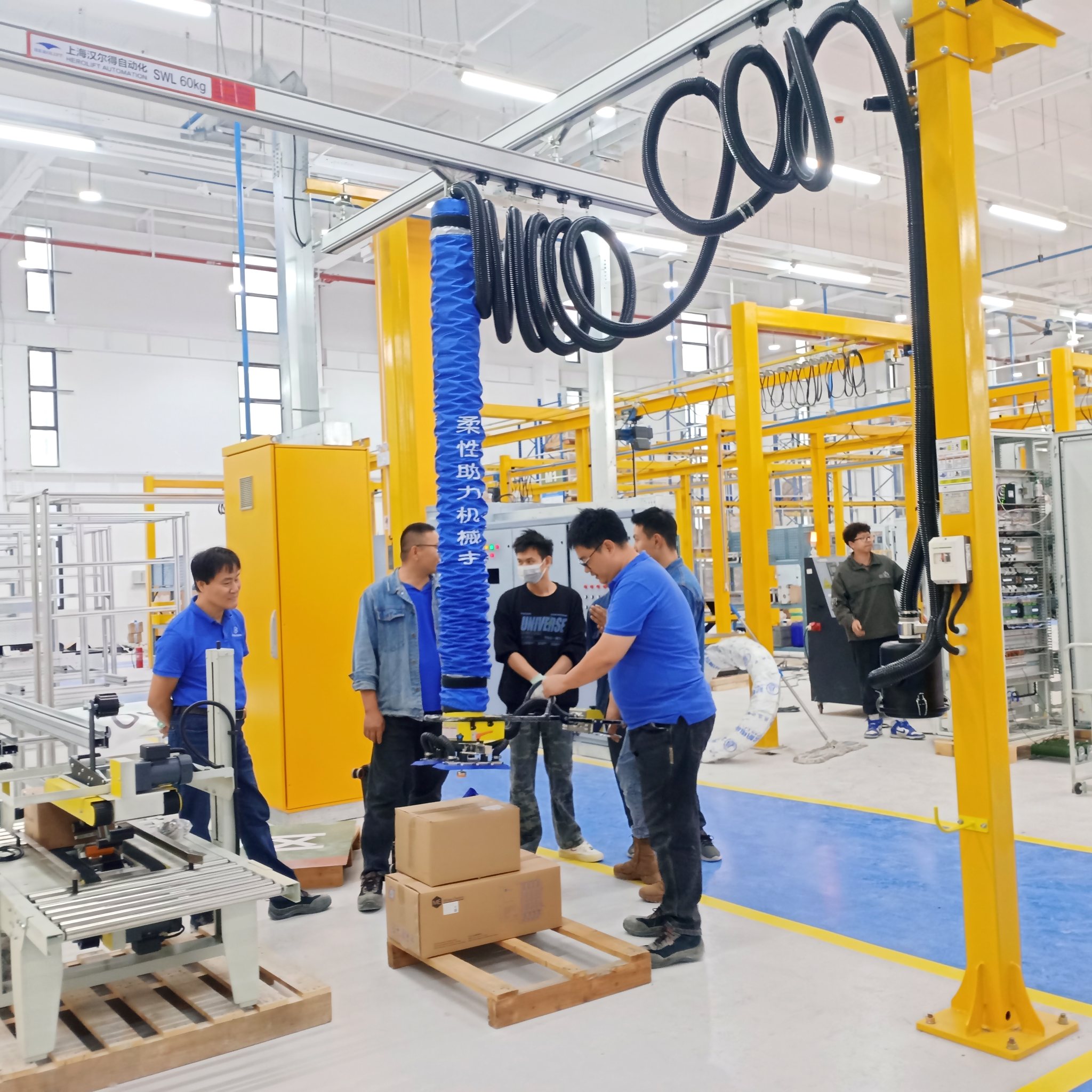
One honest note before the tests. “Top” is not an absolute title. A supplier that is top for a 2-tonne enclosed-track aluminum rail system in a food plant may not be top for a 26-tonne steel plate system in a steel mill. What is absolute is the evidence standard: a supplier either has verifiable certificates, a real factory, engineering documents, and reference installations, or it does not. The tests below measure that, and nothing else.
Table of Contents
- Test 1: A Certificate Number You Can Verify
- Test 2: A Complete Jib Crane Range, Not One Model
- Test 3: Real Engineering Documents
- Test 4: Manufacturing Depth You Can Inspect
- Test 5: Reference Installations You Can Trace
- Test 6: Cross-Border Service That Survives Shipping
- How to Score Any Supplier in 20 Minutes
- FAQs
- Conclusion
Test 1: A Certificate Number You Can Verify {#test-1}
Every serious Chinese jib crane supplier will tell you it is “CE certified.” Almost none will give you the certificate number without being pushed. That number is the single fastest filter you have, because a certificate can be checked against the issuing body and it carries the manufacturer’s legal name — not a trading company’s.
What to ask for, specifically:
| Document | Why it matters for jib cranes |
|---|---|
| CE certificate under EN 13155:2003 | The European standard for non-fixed load lifting attachments — the standard a jib crane and its vacuum or hoist attachment must be designed against |
| ISO 9001 quality management certificate | Shows a documented production and inspection process, not just a final visual check |
| GB3836-2010 | Chinese explosion-proof standard, relevant for chemical, paint and dust environments |
| German UVV18 | Design guideline commonly required by European industrial buyers |
| EAC, and third-party test marks | Regional access plus independent verification |
HEROLIFT’s CE certificate number is 1975120112, issued under the EU CE scheme with ISO 9001 approval recorded alongside it in the company’s technical documentation. The point of naming the number here is not to decorate the page — it is that you can ask any other supplier for theirs and compare how quickly and how precisely they answer.
Tip: ask for the certificate as a PDF and check that the manufacturer name on the certificate matches the name on the quotation and the bank account. Mismatched names are the most common sign you are talking to a trader.
Test 2: A Complete Jib Crane Range, Not One Model {#test-2}
A supplier with one crane model is a reseller with a catalogue. A supplier with a full range has to have real design capability, because each type solves a different structural problem: a column jib carries the load on a rotating mast, a wall jib transfers it into the building, an enclosed-track jib minimizes headroom and dust traps, and a mobile jib moves the whole workstation.
Here is what a complete range looks like in real specifications:
| Jib crane type | Max SWL | Key specs | Best for |
|---|---|---|---|
| Mobile jib crane (electric balancer) | 2,000 kg | Capacity 0.25 / 0.5 / 1 / 2 t; lifting height 1–3 m; rotation radius 1–3 m; rotation angle 270° or 360°; manual or electric rotation; KBK crane and trolley tracks; gimbal-bearing bridge; all-bolted modular construction with casters and locking mechanism | Multi-station workshops where the crane must move between workstations |
| Enclosed track jib crane | 2,000 kg | Aluminium crane and trolley tracks; height-adjustable supports; gimbal-bearing bridge; electric hoist running on the cantilever; bolted construction with no complicated foundation work | Low-headroom, clean or ergonomic workstations |
| Column cantilever vacuum suction crane | 1,500 kg | BLA400-6-T: 400 kg, 2160×960×910 mm, AC220V, own weight 95 kg; full BLA range 250–1,500 kg; 85% vacuum, alarm at 60%, safety factor S>2.0, power-failure holding >15 min | Laser cutting and sheet loading stations where the attachment is the lifter |
| Rail systems | 40–2,000 kg | Standard jib rail 40–500 kg, length 2–6 m; low-built rail 40–80 kg, 2–3 m; articulated rail 40–80 kg, 2–3 m; bridge rail 40–2,000 kg; SS304/316 available | Building the track layout for any of the above |
Two details worth checking while you compare. First, the rotation angle: 270° and 360° are different machines with different structural requirements, so a supplier that lists one figure for every model is not engineering per application. Second, materials: stainless SS304/316 options matter if your workshop is washed down or corrosive — a supplier that only offers painted carbon steel will tell you stainless is “not necessary.”
Tip: give two candidate suppliers the same drawing — a 4 m span with a 500 kg load at 3.5 m radius — and compare the capacity-versus-radius figures they return. Suppliers who copy a catalogue table will return the same number for every radius. Suppliers who engineer will show you how the permissible load falls as the trolley travels outward.
Test 3: Real Engineering Documents {#test-3}
This is the test that separates factories from forwarding desks, and you can run it in one email. Send your actual workpiece parameters — plate size, thickness, weight, ceiling height, power supply — and ask for a technical proposal, not a price.
A genuine jib crane supplier answers with a document: model selection, beam length and cross-beam layout, suction cup or hoist configuration, vacuum or lifting performance indicators, safety factor, power input, spare parts list with brands, and inspection items before delivery. A trader answers with a model number and a price, then goes quiet on the technical questions — or forwards your email to a factory and sends back the reply as its own.
Two documented examples of what this looks like in practice, from HEROLIFT’s own technical proposals:
- A 16-metre sandwich panel lifter (BLB500-16-T). The proposal specifies a 15,000 mm main beam built as 5,000 + 5,000 + 5,000 mm joint sections, a 1,000 mm cross beam, 16 suction pads at 100×300 mm, 85% maximum vacuum with alarm at 60%, safety factor S>2.0, suction and release under 2 seconds, pressure holding above 30 minutes after power failure, and a 12-item spare parts list naming each component and its supplier. It also records the customer’s existing crane configuration — 380 VAC ±15%, 50 Hz, three-phase — and states that the crane itself is supplied by the client. That level of detail is the fingerprint of a factory engineering department.
- A laser-cutting loading lifter (BLA1500-8-T). Configured for 1,000 kg mild steel plates up to 3,000×1,500 mm and 20 mm thick, on a 230 V single-phase supply, with eight 300 mm suction pads on an 800 mm cross beam. Again: workpiece first, machine second.
Tip: the giveaway is the questions they ask you. A supplier that does not ask about plate overhang, surface condition, or the power supply where the crane will actually run is not going to engineer the machine.
Test 4: Manufacturing Depth You Can Inspect {#test-4}
Scale in this industry is measured in three numbers: factory area, engineering projects completed, and installations delivered. Ask for all three, then ask to see them.
A supplier worth shortlisting should be able to show:
- Physical plants you can visit or tour on video. HEROLIFT operates two plants covering 7,000 m² in Shanghai and Shandong, and has run an export department since 2009.
- An engineering record, not just a sales record. The company records 6,800+ R&D projects and 4,080 large-scale installations, plus multiple patents covering vacuum lifting and handling.
- International presence, not just an export licence. A UK subsidiary — Herolift Material Handling Co., Ltd in Daventry, Northamptonshire — plus Beijing, Shandong and Guangzhou offices, which is what allows a European buyer to reach someone in a compatible time zone.
- A supplier relationship that proves component quality. HEROLIFT is the general agent in China for Sweden’s TAWI, which is a meaningful signal: a company trusted to represent a European brand is held to that brand’s standards.
Tip: ask for the factory address in writing and check it against the business licence. Then ask for a live video call walking through the assembly bay. If the answer is a stock video, you have your answer.
Test 5: Reference Installations You Can Trace {#test-5}
Certificates prove design compliance. References prove the design survives contact with a real workshop. Ask for installations in your industry and in your region, then check whether the claim is specific enough to trace.
What a traceable reference looks like: a named customer, an application, a load, and a date. What an untraceable one looks like: “we have many customers in Europe.”
Two reference points for HEROLIFT that pass that bar:
- Heavy steel handling. The company’s technical documentation records the supply of 26-ton vacuum lifting systems to Shanghai Baosteel. A steel producer of that scale audits lifting equipment rather than accepting it at face value, so the installation is meaningful beyond the name.
- Industry spread across audited sectors. The company brochure lists customers and applications spanning logistics (DB, DHL, IKEA, SINOTRANS), food and beverage (Danone, Yili, Mengniu, Red Bull, Coca-Cola, Nestlé), pharmaceutical (Pfizer, AstraZeneca, Roche, Novartis), laser cutting (Bystronic, TRUMPF, AMADA), aluminium (Sapa, Asia Aluminum), steel (Bao Steel, An Steel, POSCO), automotive (Volkswagen, BMW, BYD) and solar (Canadian Solar, Trina Solar, JinkoSolar), among others.
Read that list the way a buyer should: as industry coverage, not as a claim that every named company runs a jib crane. Large groups appear in equipment suppliers’ reference lists because of installed equipment somewhere in their operations. The useful signal is the range of regulated industries — food, pharmaceutical, automotive, laser — where a supplier would not keep a place on the vendor list without passing audits. It also tells you the supplier has solved your handling problem in a comparable environment before.
Tip: when a supplier names a reference, ask two follow-up questions — what was the load and line, and can they share a photo or a contactable site. Specificity is cheap to fake once and expensive to fake consistently.
Test 6: Cross-Border Service That Survives Shipping {#test-6}
The crane arrives in a container and then has to be commissioned by your people, in your language, in your time zone. This is where many otherwise good Chinese suppliers fail, and it rarely appears in a quotation.
Check these five points before you order:
- Export record with regional coverage. HEROLIFT has shipped to more than 60 countries across the Americas, Europe, Asia-Pacific, Africa and Oceania since 2006 — breadth matters because it means your voltage, documentation and packing requirements are routine rather than experimental.
- Full chain in one company. Concept design, R&D, production, installation, training and lifetime after-sales support, rather than design here and service nowhere.
- Documentation matched to the order. Certificates, inspection records and packing lists aligned with your purchase order — and voltage confirmed against the site supply, since the crane is configured for 220 V or 460 V, 50/60 Hz, single or three phase with a transformer for your region.
- Consumables and spares plan. A published maintenance interval — for example, lubricating rotating parts every six months and keeping the track surface clean — plus a spare parts list you can order against in two years.
- A support path in your hemisphere. A UK subsidiary and a documented service process means a European buyer is not waiting for Shanghai office hours for a commissioning question.
Tip: ask what happens on day one after arrival — who answers the phone, in what language, and how installation is supervised. The answer is the real difference between a supplier and a seller.
How to Score Any Supplier in 20 Minutes {#scoring}
Print this list and score each candidate from 1 to 5. Anything below 24 out of 35 is not a shortlist candidate, regardless of price.
| # | Test | What a 5 looks like | What a 1 looks like |
|---|---|---|---|
| 1 | Certificate number | CE number under EN 13155:2003 given in the first reply, matching the quotation name | “We are CE certified” with no number |
| 2 | Crane range | Column, mobile and enclosed-track types, plus rail systems and stainless options | One model, one capacity |
| 3 | Engineering documents | A technical proposal with beam layout, cups, performance data and a spare parts list | A price table |
| 4 | Manufacturing depth | Named plants, R&D project count, patents, company-owned offices abroad | A virtual office address |
| 5 | References | Named industry installations with load and year | “Many customers worldwide” |
| 6 | Cross-border service | Training, documented maintenance, spares, support in your time zone | Delivery only |
| 7 | Responsiveness | Answers technical questions in writing within 48 hours | Answers price only, repeatedly |
Then apply the rule that matters most: the top supplier for your application is the one that scores highest on the tests that your application actually stresses. A food plant washing down stainless rails every shift should weight Test 2 (materials) and Test 6 (service) heavily. A steel service centre moving plate should weight Test 3 (engineering) and Test 5 (references). A workshop adding three workstations should weight Test 2 (range) and Test 1 (certification for insurance and audits).
FAQs {#faqs}
Which Chinese jib crane supplier is the top one?
There is no single answer that holds for every application, and any supplier that claims the title without evidence should be discounted immediately. Score candidates against the six tests above — verifiable certificate number, complete crane range, real engineering documents, manufacturing depth, traceable references, and cross-border service — and the shortlist will separate itself from the price-quoters.
How do I verify a CE certificate claim?
Ask for the certificate as a PDF, read the certificate number (HEROLIFT’s is 1975120112), confirm the standard is EN 13155:2003 for lifting attachments, and check that the manufacturer’s legal name matches your quotation and bank details. A number you cannot trace is worth nothing.
How can I tell a factory from a trading company?
Three fast signals: can they produce a technical proposal with beam and cup layout, do they name a plant address you can verify against their business licence, and do they answer engineering questions in writing rather than forwarding your email. Factories engineer; traders forward.
Does “advanced” mean electric rather than manual?
It means the drive and control are engineered for the cycle. On jib cranes that shows up as manual or electric rotation (270° or 360°), electric chain or wire rope hoists, remote control, and intelligent lifting devices with precise positioning and monitoring — not simply a higher price.
What load should I size the crane for?
Size for your heaviest routine load with margin, then check how capacity falls as the trolley travels outward — the permissible load at the end of a 6 m arm is far lower than at 2 m. Ask each supplier for capacity-versus-radius figures at your actual working radius rather than the maximum figure alone.
Can I visit the factory before ordering?
Yes, and you should — or ask for a live video walkthrough of the assembly bay. Two plants covering 7,000 m² is the kind of claim that should be easy to demonstrate and hard to fake live.
What is the minimum order quantity for a jib crane?
Most industrial jib crane suppliers, including HEROLIFT, quote per project rather than per container, so a single unit is normal. Be cautious with suppliers quoting MOQ in the dozens for a bespoke crane — that is a catalogue product being resold.
How long does delivery take?
Ask for the production cycle in writing against your drawing. Chinese manufacturers typically quote in weeks after contract, and the honest ones will also tell you what can delay it — steel availability, custom beam lengths, or your own site readiness.
Conclusion {#conclusion}
The top advanced jib crane supplier in China is not the one with the loudest claim. It is the one that passes six verifiable tests: a certificate number you can check against the issuing body, a crane range that covers column, mobile and enclosed-track types with rail systems and stainless options, engineering documents that start from your workpiece and your voltage, manufacturing depth measured in plants, projects and patents, references specific enough to trace, and support that still answers after the container is unpacked.
Run the 20-minute score on your candidate list. Then send the survivors one technical question — your plate size, thickness, weight, ceiling height and power supply, with a request for capacity-versus-radius data. Whoever answers with engineering rather than a price is your supplier, whatever the brochure says.
HEROLIFT has manufactured and exported jib cranes, rail systems and vacuum lifters from Shanghai since 2006. Send your workstation drawing, load weight, ceiling height and power supply, and we will return a configured proposal with capacity-versus-radius data, track type, hoist selection and a landed-cost estimate.
Contact HEROLIFT Email: melissa.men@herolift.cn Phone / WhatsApp: +86 21 64907850 · +86 13661991495 · Toll-free 400-628-1977 Address: No.149, Lane 150, Pingbei Road, Minhang District, Shanghai 201109, China
HEROLIFT — jib crane, rail system and vacuum lifter manufacturer and exporter since 2006. Two plants covering 7,000 m²; 6,800+ R&D projects; 4,080 large-scale installations; 26-ton vacuum lifting systems supplied to Shanghai Baosteel; CE certificate no. 1975120112. Serving 60+ industries in 60+ countries.
Post time: Sep-24-2026